Wearing the Starry Sky on Your Apple Watch
sekiguti shinichi | March 7, 2026
wadokei57 — App Store Page wadokei57 — Download Link
Karakuri Giemon — Tanaka Hisashige
I once watched an NHK documentary about recreating the Mannen Jimeishō — an extraordinarily complex mechanical clock built by Meiji-era engineer Tanaka Hisashige. I vaguely remember seeing the real thing at the National Museum of Nature and Science in Ueno as a child, but I had no idea at the time just how remarkable it truly was.
Tanaka Hisashige founded the company that would eventually become Toshiba, and was one of Japan's most prolific inventors, active from the late Edo period through the Meiji era.
In the late Edo period, he created intricate karakuri automata and performed with them publicly, earning the nickname "Karakuri Giemon" (Automaton Giemon). One of his most celebrated works was the Yumihiki Doji — an archer automaton that performed a complete sequence: grasping an arrow, nocking it to the bow, drawing, releasing, and hitting the target, all while moving its head and fingers with uncanny realism.
In an age without electricity, achieving such fluid, lifelike motion through purely mechanical means is astonishing. Rather than simply engineering a function, he created something that spoke to the human senses — much like the puppets of Bunraku theater. It was art as much as invention.
The Miracle Timepiece — The Mannen Jimeishō (Perpetual Clock)
Tanaka Hisashige studied under the Tsuchimikado family — hereditary astronomers and calendar scholars who had served the Imperial Court for generations — and channeled all of that accumulated knowledge into a single creation: the Mannen Jimeishō, a multi-function astronomical timepiece.
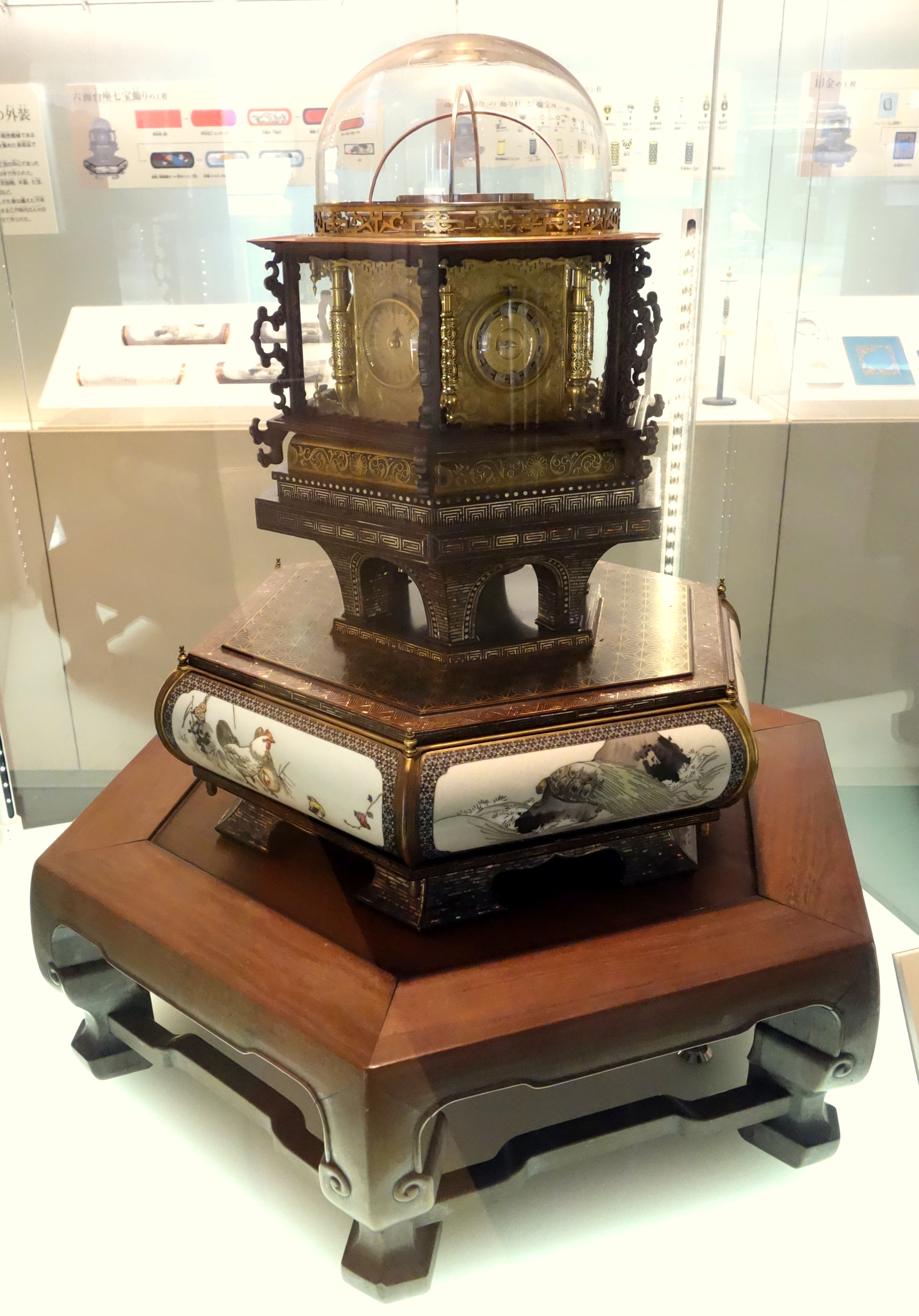
Replica of the Mannen Jimeishō — Toshiba Science Museum
The clock is shaped like a hexagonal column, with a different display on each of its six faces, each serving a distinct function:
Face 1 — Japanese Temporal Clock (Warigoma-shiki Wadokei)
- A traditional Japanese clock using the variable-hour (futeijihō) system, along with the 24 Solar Terms
- The outer ring of character tiles shifts position over a one-year cycle
- The center hand completes one rotation per year, indicating the Solar Term
- The entire dial rotates once per day to show the Japanese temporal hour
Face 2 — 24 Solar Terms
- A memo panel for handwriting in the Solar Term dates; the center hand is adjusted manually
Face 3 — Day of the Week & Time
- Displays the day of the week in conjunction with Face 1's temporal clock
- A short hand completes one revolution every 7 days (day of week)
- A long hand completes one revolution per day (temporal hour)
Face 4 — Jikkan Jūnishi (Ten Heavenly Stems & Twelve Earthly Branches)
- Center hand: one revolution every 12 days (day's Earthly Branch)
- Outer dial: one revolution every 10 days (day's Heavenly Stem)
Face 5 — Moon Age & Lunar Calendar
- A central sphere, half white and half black, rotates to show the moon phase
- The outer hand and sphere each complete one revolution in 28 days
Face 6 — Western Clock
- A standard mechanical timepiece; uses an existing pocket watch movement
Celestial Globe (Tenkyūgi)
- A small sphere on a wire above a map of Japan indicates the three-dimensional positions of the sun and moon
- A rotating hemisphere carries the sun (one revolution per day)
- A gear on that hemisphere moves the moon (one revolution per 28 days)
- A fixed ring tilts the hemisphere's axis back and forth over the course of a year, representing the seasonal change in solar altitude
All six faces and the celestial globe are mechanically linked — together they visualize the flow of time as created by the movements of Earth, Moon, and Sun. And once wound, the clock runs continuously for a full year.
The Mannen Jimeishō is now on permanent display at the National Museum of Nature and Science, following several restorations. In preparation for Expo 2005 Aichi, a national project was launched to disassemble, study, and build a replica using modern techniques. During that process, the remarkably sophisticated warigoma mechanism of Face 1 was fully revealed for the first time.
- Toshiba Heritage Square — About the Mannen Clock
- NHK Documentary on Tanaka Hisashige's Perpetual Clock — YouTube
The mushiba-guruma ("worm gear") mechanism — a name coined during the restoration — is unique in the world to this clock, and is an elegantly efficient solution for converting rotary motion into reciprocating motion.
A Clock That Explains the Heliocentric Model — The Shumisen-gi
Shumisen-gi — Seiko Museum Ginza
A brief digression — I'd also like to introduce another of Tanaka Hisashige's creations: the Shumisen-gi (Mount Sumeru Orrery).
The manga "Chi." — On the Movement of the Earth depicts the struggle to prove the heliocentric model of the solar system, centering on the tension between science and religion. I watched every episode on Netflix in one sitting. (For those without Netflix, it was free on ABEMA TV until March 15, 2026 — well worth seeking out.)
Buddhism introduced the geocentric Mount Sumeru cosmology to Japan. According to this worldview, the universe is centered on Mount Sumeru — an imaginary mountain inhabited by Indra and the Four Heavenly Kings. Surrounding it are nine mountains and eight seas (Kumyakkais), within which lie four continents. The southern continent, Nansenbushū, is where humanity resides.
The boundaries of this world are encircled by gold and water rings, and the edge of that boundary — Konrinzai — gives us the Japanese idiom for "absolutely" or "to the very limit." The peak of Mount Sumeru, incidentally, is called Uchōten — the origin of the word for "ecstasy" in Japanese.
What's fascinating about this ancient Indian cosmology is its sheer scale. It imagines realms beyond the Sumeru universe, with vast cosmic space measured in units of 1,000, then 1,000,000, then 1,000,000,000 Sumeru worlds — the Sanzendaisen Sekai (Three Thousandfold World System). Time operates on an equally vast scale, cycling through four ages (yugas): Satya, Treta, Dvapara, and Kali — together forming one Maha Yuga of approximately 4.32 million years. A thousand Maha Yugas form one kalpa (~4.32 billion years) — equivalent to one day in the life of Brahma, the Hindu creator deity.
When the heliocentric model arrived in Japan in the late 1700s, it alarmed some Buddhist clergy. The Tendai monk Entsū launched a campaign to promote the geocentric Mount Sumeru cosmology, publishing books to counter heliocentrism. His disciple Kanchū commissioned Tanaka Hisashige to build the Shumisen-gi — a mechanical model of the Sumeru universe.
The device features a warigoma-style Japanese clock on its exterior and a celestial globe on top showing the sun and moon orbiting Mount Sumeru. Whether Hisashige himself believed in the geocentric model is unknown, but building the Shumisen-gi directly inspired the later creation of the Mannen Jimeishō. Nine examples survive today; one is on permanent display at the Seiko Museum Ginza, which I visited recently.
The Dream of a Wadokei Wristwatch
Watchmaker Masahiro Kikuno was so moved by the NHK documentary about the Mannen Jimeishō that he became the world's first person to successfully miniaturize a wadokei into a wristwatch. That achievement earned him a place among the world's 34 independent watchmakers — the highest recognition in the craft.
An independent watchmaker conceives every mechanism from scratch and hand-crafts every single component. The parallel with Tanaka Hisashige is striking: both embody the union of meticulous research, extraordinary technical skill, and a singular vision. Such work demands a price to match — far beyond what most of us can afford.
So I asked myself: Could I recreate a wadokei on an Apple Watch? And then I decided to try.
Design Philosophy for the Wadokei App
My goals for the project:
- Reproduce the beautiful shifting of the warigoma character tiles over the course of a year
- Recreate as many functions of the Mannen Jimeishō as possible
- Make it relevant and appealing to a global audience
- Add Apple Watch–native features such as GPS integration
- Give people a way to reconnect with Natural Time — the rhythm of the natural world
From the Mannen Jimeishō, I chose to implement the following core functions:
- Face 1 — Variable-hour Japanese clock (warigoma-shiki wadokei)
- Face 2 — 24 Solar Terms display
- Face 5 — Moon phase display
- Face 6 — Standard (Western) time display
- Celestial Globe — Azimuth and altitude of sun and moon
In addition, I added original features unique to the app:
- Star and constellation display
- Japanese lunar names for the moon based on its phase
- World clock — set city name, latitude, and longitude
- GPS support — calculates local sunrise/sunset for accurate wadokei display
- Southern Hemisphere moon phase correction (left/right mirrored)
- Crown rotation for time travel
- Starry sky display mode (rotates with compass direction on tap)
- Multilingual support — English, Chinese, Korean
Japanese Time vs. Western Time
Japanese temporal timekeeping and Western timekeeping don't merely use different reference points — they reflect fundamentally different philosophies:
| Japanese Time | Western Time |
|---|---|
| Based on nature | Based on human convention |
| The machine adapts to people | People adapt to the machine |
| Varies with the season | Always constant |
| Rooted in place and life | Rooted in nation and authority |
Of course, the benefits of a standardized global time system are enormous. But I hope this app can serve as a small invitation to rediscover the kind of time that once governed everyday life in Japan — time grounded in the movement of celestial bodies.
Under today's time zone system, large countries like China use a single unified zone, creating gaps of up to two hours from east to west. In Beijing's morning, the sun may not yet have risen over Ürümqi in Xinjiang.
In Europe, time aligned with the sun is known as Natural Time, and is recognized as beneficial for maintaining healthy, daylight-synchronized daily routines.
Japan's futeijihō (variable-hour system) is, I believe, a powerful model for achieving exactly that kind of healthy, sun-aligned living.
Technical Challenges
Because the wadokei is based on local sunrise and sunset times, the app must obtain the device's latitude and longitude and calculate those times accurately — and do so consistently for any location in the world.
I initially tried correcting local time using UTC offset, but keeping all the calculations consistent proved difficult. I eventually settled on using UTC (Coordinated Universal Time) as the universal reference. For sunrise and sunset calculations, I used the open-source SunCalc library, which solved the problem elegantly.
Star display and moon phase animation were also built using publicly available astronomical algorithms and source code.
Reading the Completed Wadokei Dial
Main Clock Screen
- The outer rotating donut dial completes one full counterclockwise revolution every 24 hours
- The red fixed hand at the top shows the current time
- The red center hand is not a time hand — it's the seasonal hand, completing one revolution per year
- The outer ring (1–24) shows standard time; the inner ring shows the twelve zodiac hours (futeijihō)
- The sky gradient background (donut shape) transitions between day and night colors, with 卯 (Rabbit / Sunrise) and 酉 (Rooster / Sunset) as the boundaries
- The inner color ring is divided into spring, summer, autumn, and winter (90° each, starting at 12 o'clock = Spring Equinox), with each season further subdivided into the 24 Solar Terms, each shown in its own seasonal color
Note: A step-counting feature that changed numeral colors based on hourly step counts was removed following Apple's review guidelines.
The Meaning of the Zodiac Hours
According to wadokei.org — maintained by a British wadokei enthusiast — each zodiac hour carries the following meaning:
| Hour | Animal | Meaning |
|---|---|---|
| 子 | Rat | Midnight — when the Rat is most active |
| 丑 | Ox | Early night — when the Ox is chewing the cud |
| 寅 | Tiger | Late night — when the Tiger prowls for food |
| 卯 | Rabbit | Sunrise — when the Rabbit forages for food |
| 辰 | Dragon | Early morning — when the divine Dragon rises to control the rain |
| 巳 | Snake | Mid-morning — when the Snake becomes active |
| 午 | Horse | Midday — when the Horse cavalry returns from drill |
| 未 | Sheep | Early afternoon — when the Sheep is eating grass |
| 申 | Monkey | Mid-afternoon — when the Monkey hunts for scraps |
| 酉 | Rooster | Sunset — when the Rooster returns to roost |
| 戌 | Dog | Early evening — when the Dog keeps watch |
| 亥 | Boar | Late evening — when the Boar forages in the quiet |
Turning the crown moves time forward or backward in one-day increments. The 24 Solar Terms display and moon phase update accordingly. After 7 seconds of inactivity, the display returns to the current time. Swipe to switch to the starry sky mode and view the night sky for any chosen date.
24 Solar Terms Display
Starting from 12 o'clock and rotating clockwise, the seasonal hand moves through Spring, Summer, Autumn, and Winter — completing one full revolution per year. The tip of the hand displays the current moon phase. In the Southern Hemisphere, the moon's crescent is mirrored left-to-right for accuracy.
The hand itself was modeled after the hands from an antique wall clock I bought at a vintage shop. The round hole in the original hand became the perfect window for displaying the moon.
The fixed pointer was adapted from an image of the Mannen Jimeishō's fixed hand, edited in Canva.
Turning the crown animates the seasonal hand and updates the Solar Term label in the upper right. Many of the 24 Solar Terms are unfamiliar to modern readers — I hope the app becomes an opportunity to reconnect with the seasonal rhythms that once shaped farming and daily life.
The 24 Solar Terms are not uniquely Japanese — they are a shared cultural heritage of China, Korea, and Japan, and have been designated as UNESCO Intangible Cultural Heritage.
Spring
- Risshun (立春) — The calendar beginning of spring
- Usui (雨水) — Snow turns to rain; ice begins to melt
- Keichitsu (啓蟄) — Hibernating insects emerge from the ground
- Shunbun (春分) — Spring Equinox; day and night are equal
- Seimei (清明) — All things are clear and alive
- Kokuu (穀雨) — Spring rains nourish the fields
Summer
- Rikka (立夏) — The calendar beginning of summer
- Shōman (小満) — Plants grow lush; the world feels full
- Bōshu (芒種) — Time to sow rice and grain
- Geshi (夏至) — Summer Solstice; the longest day
- Shōsho (小暑) — Heat begins in earnest
- Taisho (大暑) — The height of summer heat
Autumn
- Risshū (立秋) — The calendar beginning of autumn
- Shosho (処暑) — The peak of heat passes
- Hakuro (白露) — White dew forms on grass and flowers
- Shūbun (秋分) — Autumn Equinox; day and night are equal again
- Kanro (寒露) — Dew turns cold; autumn deepens
- Sōkō (霜降) — First frost falls
Winter
- Rittō (立冬) — The calendar beginning of winter
- Shōsetsu (小雪) — Light snow begins to fall
- Taisetsu (大雪) — Heavy snow accumulates
- Tōji (冬至) — Winter Solstice; the shortest day
- Shōkan (小寒) — Cold deepens (Kan no iri — the cold season begins)
- Daikan (大寒) — The coldest period of the year
Starry Sky Mode
Swipe right to enter the full starry sky view.
Unlike a traditional planisphere (which reverses East and West so you can hold it overhead), this app displays the sky aligned with the compass — because it's worn on the wrist.
The app displays approximately 1,000 naked-eye stars, sized by magnitude, with each star's color reproduced from an astronomical database. The display is small, so individual constellations can be hard to read — but the Summer Triangle, Winter Triangle, North Star (Polaris), and South Celestial Pole are highlighted for orientation.
Tap to enter compass mode, and the starry sky rotates to match your real-world orientation — perfect for locating the sun or moon even on a cloudy day.
Time Travel in Starry Sky Mode
Turning the crown moves time in 10-minute steps; tap to return to the present.
Combine both modes: use the clock screen's crown to set the date (1-day steps), then swipe to the starry sky and fine-tune with the crown (10-minute steps). Swipe back or tap the sky to return to the current time.
Location Settings Screen
The settings screen lets you choose cities from around the world. Tap "Update Current Location" to use GPS and automatically set your position for accurate astronomical calculations.
Finally on the App Store
After three rejections, the app was finally approved and published.
Apple's review process runs on US time — reviews typically begin around midnight to 2 AM Japan time. On submission nights, I could barely sleep. When rejection notices arrived at 3 or 4 AM, I would start fixing the issues immediately.
Rejection 1: I had used the Workout API to keep the display on continuously. Apple determined this was only permitted for health apps. I removed it and resubmitted.
After the second submission, the review sat in a queue over the weekend — nearly four days. The result: the step-counting feature was deemed unrelated to the app's core purpose and had to be removed. I rushed to strip out the step counter and authentication logic before my morning work shift.
Rejection 3: In my haste, a localized string requesting health permissions had survived in the multilingual files. Another rejection. I combed through every source file and configuration, confirmed there were no remaining references, and resubmitted.
The app was finally approved.
How to Install wadokei57
wadokei57 — Moon, Sun & Star Clock
Or search "57" in the App Store directly on your Apple Watch. (Searching on iPhone via the App Store and installing from there is generally easier — search "wadokei57".)
Apple Watch app installation can be a little tricky. The following Apple Support page may help:
I'd love it if you downloaded the app right away — but I'm also planning to distribute promo codes for a free install to anyone who reviews or shares the app on social media. Details will be posted on this page when ready.
News
2026.03.12 Ranked #21 in the Paid Utilities category on MSY Games, an app review site. MSY Games — Top 100 Paid Utility Apps
2026.03.14 Featured on the app review site APPLION. APPLION — "wadokei57 Moon, Sun & Star Clock"
#WhenIGetObsessed #AppleWatch #Planetarium #OnTheMotionOfTheEarth #AppDevelopment #Wadokei #PerpetualClock
sekiguti shinichi I buy houses on a whim, and dive into whatever catches my interest — biology, artificial life, app development, violin, DIY renovation, diatom microscopy, 3D printing, and more. Certified nursery teacher & social worker. Co-author: "Introduction to PC-based Astronomical Observation."